KEY ELEMENTS OF AGILE RETROSPECTIVES

The star structure is one way teams choose to structure retrsopectives.
Source: AgileRetrsopectives.com (Parsons, 2015)

Whilst conducting an agile retrospective, it is imperative to consider essential elements that must be included. The purpose of any retrospective is to aid a development team in identifying what worked and what did not throughout a project. During the retrospective phase, strengths and weaknesses as well as opportunities for improvement are uncovered so that actionable steps can be taken to improve the team’s success. The best measure of a retrospective is the trend of success over time, from project to project. Throughout this article, you will find an explanation of what can be found in a high-quality retrospective.

Celebrating Achievements

It’s critical to state what was done well. Not only does it increase the morale of the team, it also is a way to evaluate how successful changes were made so that those conditions can be mirrored on future projects (Hazrati, 2009). Mutual beneficial outcomes will occur as team members feel recognized and the team examines the circumstances under which they are most likely to succeed.

Image result for improvement
New ideas that emerge throughout the retrospective process spark change and long-term improvement on project teams.
Source: GlobalOutsourcing.com (Smith, 2019)

Examining Issues

What was unsuccessful? Why was it in unsuccessful? It’s important that team members feel comfortable being candid and open about what went wrong. The team must work together to examine patterns and potential contributors. It’s important that  blame is not placed and problems are examined closely and understood, rather than attempting to resolve immediately (Crowder, 2015). Before the evaluating improvements phase of the retrospective, relevant variables must be identified and feedback should be collected. It is common that throughout doing so, the root cause is uncovered and the improvements that are suggested thereby become more appropriate and effective.

Evaluating Improvements

This is the actionable step where a plan is created to improve. Given that everyone on the team feels heard and issues have been brought to light, the team must shift their focus from the past to the future. Everything the team decides to start and stop doing should directly relate to a problem being solved and be realistically able to be implemented. Major process and structural changes can uproot and overwhelm team members. This is why it is important to make sure the solutions relate directly to the problems addressed. The relation between issue and improvement should be clear to everyone. Finally, improvement occurs over time (Atlassian, 2019). All issues will not be fixed over one sprint or even a single process as agile is a dynamic, iterative process and teams are constantly pivoting to address new concerns.

Sources:

Atlassian. “How to Run an Agile Retrospective Meeting with Examples.” Atlassian, Atlassian, http://www.atlassian.com/team-playbook/plays/retrospective.

Crowder, J., & Friess, S. (2015). Agile Project Management: Managing for Success. Cham: Springer International Publishing.

Hazrati, Vikas. “Key Elements of a Successful Agile Retrospective: Preparation and Participation.” InfoQ, InfoQ, 8 Sept. 2009, http://www.infoq.com/news/2009/09/key-elements-agile-retrospective.

Utilization of Scrum and Kanban in Business

Scrum is known as a framework for agile development that focuses on helping teams work together in software development. Scrum is nicknamed after the rugby formation that helps teams function cohesively and with maximum output.

Kanban is a visual workflow management tool that like scrum, serves to optimize workflow and in turn, make teams more efficient. Kanban is a Japanese term that translates to “visual card,” hinting at the visual nature of the system.

Kanban and Scrum are excellent tools and increasingly utilized by project managers in small and large companies alike (Crawley, 2018). It is critical for emerging project management professionals to understand both.

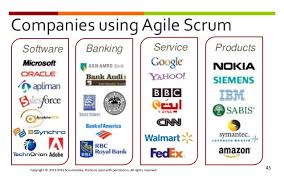
Companies that use Scrum are plentiful and include many Fortune 500 household names. Among these are Google, Facebook, CNN, Bank of America, Adobe, and Nokia. This suggests that Scrum is a useful project management tool across a wide array of industries including, but not limited to, technology, banking, and broadcasting (Smith, 2011). Their diverse revenue streams and wide array of project types make an organized and team-focused framework such as Scrum highly suitable.

A diverse range of companies utilize scrum agile framework.
(Scrumtopia, 2013)

Companies that use Kanban include many creative companies that employ artistic and visually inclined people. Among the list are Pixar, an animation company, Zara, a fashion company, and Spotify, a popular music-streaming service. These companies are all focused on innovation and building products that meet the needs set by current trends and styles (Lily, 2008). The ability to work quickly and adapt to changes in an optic manner cannot be undervalued for these businesses.

Image result for kanban companies
The visual nature of Kanban seen in the layout above suits creative companies.
(Smith, 2014)

No matter which company someone is aspiring to work at, or even if they are starting their own venture, Kanban and Scrum are useful investments in professional development resources.

Citations:

“Certification Types & Tracks.” Foundational & Advanced Scrum Training & Certifications, 2019, http://www.scrumalliance.org/get-certified.

Crawley, Chris. “Which Is The Best SCRUM MASTER Certification?” LinkedIn, 20 Apr. 2017,http://www.linkedin.com/pulse/which-best-scrum-master-certification-chris-crawley-csm.

“Professional Scrum Master I.” Scrum.org, Scrum.org, 2019, http://www.scrum.org/professional-scrum-master-i-certification.

“What Is a Scrum Master?” Scrum.org, http://www.scrum.org/resources/what-is-a-scrum-master.

Scrum Alliance. “Who Is Scrum Alliance®.” About Us, http://www.scrumalliance.org/about-us.


Agile Business Analyst Careers

The work of an agile business analyst is highly rewarding and such positions are well sought-after. However, the title can be quite ambiguous and lead to many questions related to the requirements and trajectory of this career path. Students and professionals alike must first understand the qualifications of an agile business analyst in order to be successful in their job-hunting pursuits.

Image result for grad cap and diploma clipartMost companies require business analysts to have a minimum of a bachelor’s degree from an accredited, four-year program (BA Times, 2019). While the work is not highly specified as compared to that of a doctor who would go to school to practice medicine for the specific type of patient they will treat, it does require a versatility in skill-set and general business acumen. For this reason, many hiring managers look for degrees in areas that emphasize mathematics proficiency, communication skills, and sound decision-making. These include business administration, marketing, economics, and information technology. While each employer requires a different level of technical skill, including knowledge of programming languages, job-seekers will find an emphasis on soft skills that are harder to teach since companies know that necessary technical knowledge can be delivered through on-the-job training and even certification programs. Those seeking positions at higher levels will usually need to obtain a Masters in Business Administration (MBA) or similar degree.

The nature of the agile methodology requires that a business analyst be nimble and skilled in responding to change. Additionally, the way in which the individual is able to communicate customer needs through requirements specification directly correlates with the success of both the projects they work on and their own career in the industry. Agile methodology involves seeking out feedback at every step of the process, thereby allowing the business analyst to understand quickly whether they are appropriately conveying the vision of the customer and translating it into requirements that are clear for the development team (Study.com, 2018). They, too, will often fail quickly due to the constant feedback and Image result for communication people talking clipartevaluation they will receive, thus allowing them to determine whether the agile business analyst role is the right fit for him. Likewise, positive feedback translates into career growth and opportunities such as promotions to a strategy-based role at the executive level.

Finally, many companies look for certifications when selecting between two qualified candidates. Such credentials can distinguish one candidate from another by verifying they have the skills relevant to the job and are familiar with industry standards. The most common certification is the Agile Analysis certification (IIBA) through the International Institute of Business Analysis (IIBA Homepage, 2019). In particular, organizations transitioning from legacy systems and antiquated waterfall methodology may seek out individuals with agile-intensive certifications to help them implement organizational changes and set company-wide standards.

In conclusion, the career of a business analyst can bring great fulfillment, especially to those who actively seek out personal development opportunities, both formal and informal.

Citations:

“Agile Analysis (IIBA-ACC) | IIBA.” IIBA Homepage. 15 Apr. 2019 <https://www.iiba.org/certification/specialized-business-analysis-certifications/agile-analysis/&gt;.

Batimes. “Career choices for a Business Analyst – What Options does a BA Have?” BA Times. 15 Apr. 2019 <https://www.batimes.com/articles/career-choices-for-a-business-analyst-what-options-does-a-ba-have.html&gt;.

Study.com. Study.com. 15 Apr. 2019 <https://study.com/become_a_business_analyst.html&gt;.

Responding To Change & Revising A Plan

Author: Hunter Healy

Pivoting From An Initial Plan With Ideation
Source: Wired 2017

Historically, throughout business, it has been customary to follow a carefully devised road map. The standard assumption is that in order to get to where you’re going, you have to follow the plan set out to get you there. This adage doesn’t hold up to the same extent in regards to agile product development. While it’s important to acknowledge that the planning phase is critical to the success of an agile project, it’s the ability to be nimble and adapt to unforeseen change that distinguishes agile development from other methodologies, such as waterfall (Aaron).
As a customer’s requirements change, so do the constraints on the project. With each sprint, it is critical to evaluate whether the team is still on track, as measured by progress toward customer deliverables. Should changes need to be made, it is characteristic of an agile team to quickly course-correct (DBS Interactive). This differs vastly from the nature of a waterfall team which often does not identify and evaluate necessary changes until project completion when it is too late to account for factors such as changes in the market and the customer’s needs.
Now that we have identified the ways in which an agile team rapidly adapts to an evolving plan, it’s important to identify the tools they use to respond in such scenarios. The unique structure of an agile team is perhaps their most valuable asset in adapting to change. By operating in sprints, the amount of work completed before realizing a feature is obsolete or perhaps, an additional feature is needed, is minimalized. Progress made that is no longer relevant to the updated product needs is limited to the course of weeks as opposed to the span of months to even years (DBS Interactive).
In conclusion, by maximizing the efficiency and relevance of current team tasks to the fulfillment of project deliverables, agile teams are able to quickly adapt their initial plan, saving both money and time in the long-run.

Adaptation In Accordance With Change
(Park & Myers)

Citations:

Aaron. “Agile Manifesto: Responding to Change.” Platinum Edge, Platinum Edge, 23 Sept. 2012, platinumedge.com/blog/agile-manifesto-responding-to-change.

Aaron. “Agile Manifesto: Responding to Change.” Platinum Edge, Platinum Edge, 23 Sept. 2012, platinumedge.com/blog/agile-manifesto-responding-to-change. Accessed 8 Apr. 2019.

“Agile Beyond Software – Responding to Change.” InCrowd, 24 Aug. 2017, incrowdnow.com/blog/agile-beyond-software-responding-to-change/.

DBS Interactive. “Embracing Change: How Agile Is Transforming Project Management.” DBS Interactive, (Open in New Window), 16 May 2018, http://www.dbswebsite.com/blog/2016/06/07/embracing-change-how-agile-is-transforming-project-management/.